
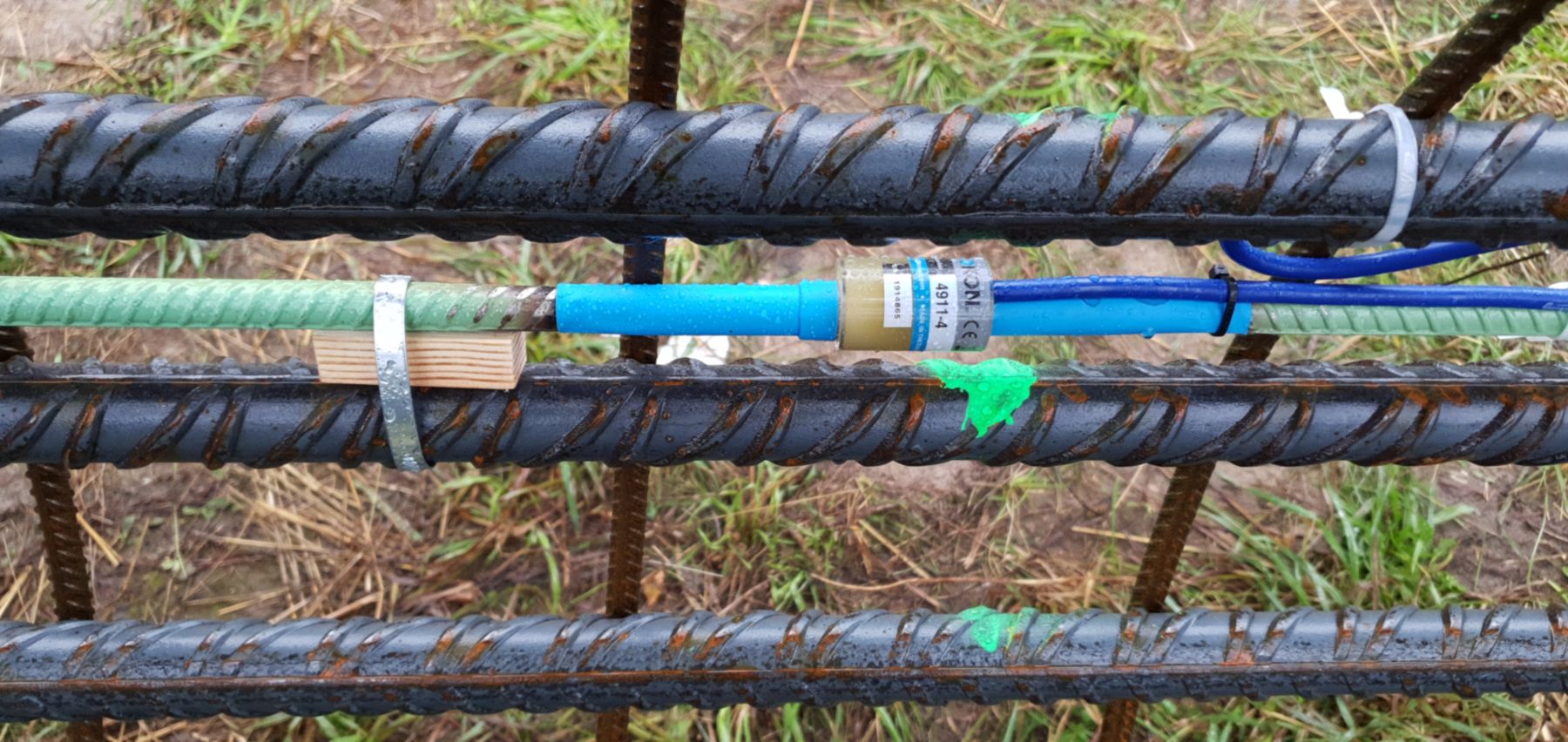
Vibrating wire gauges (sister bars)
Measure strain in the concrete, mounted on the reinforcement cage at several levels over the pile length. Strain gives the normal force and from that the shaft friction between levels.
strain per level
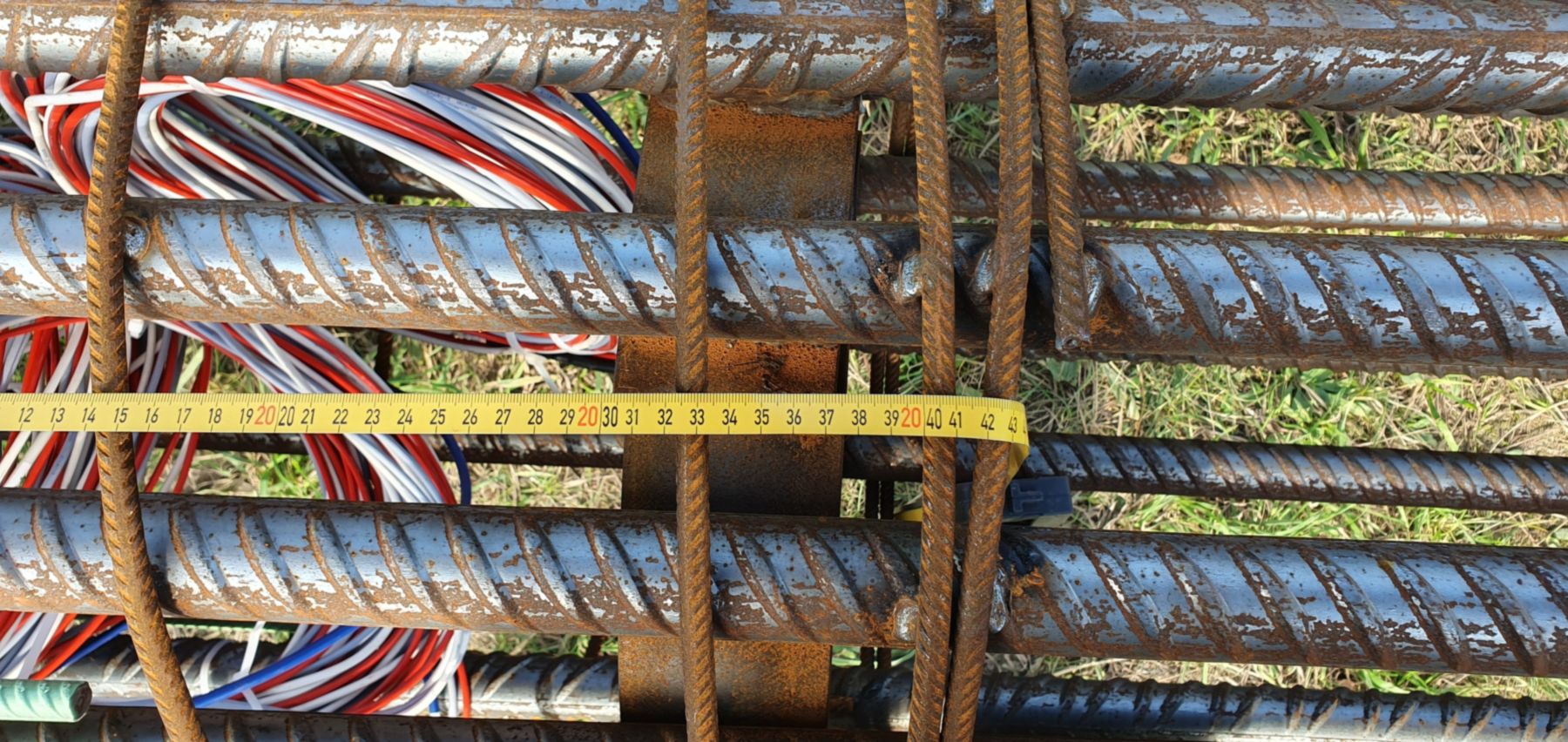
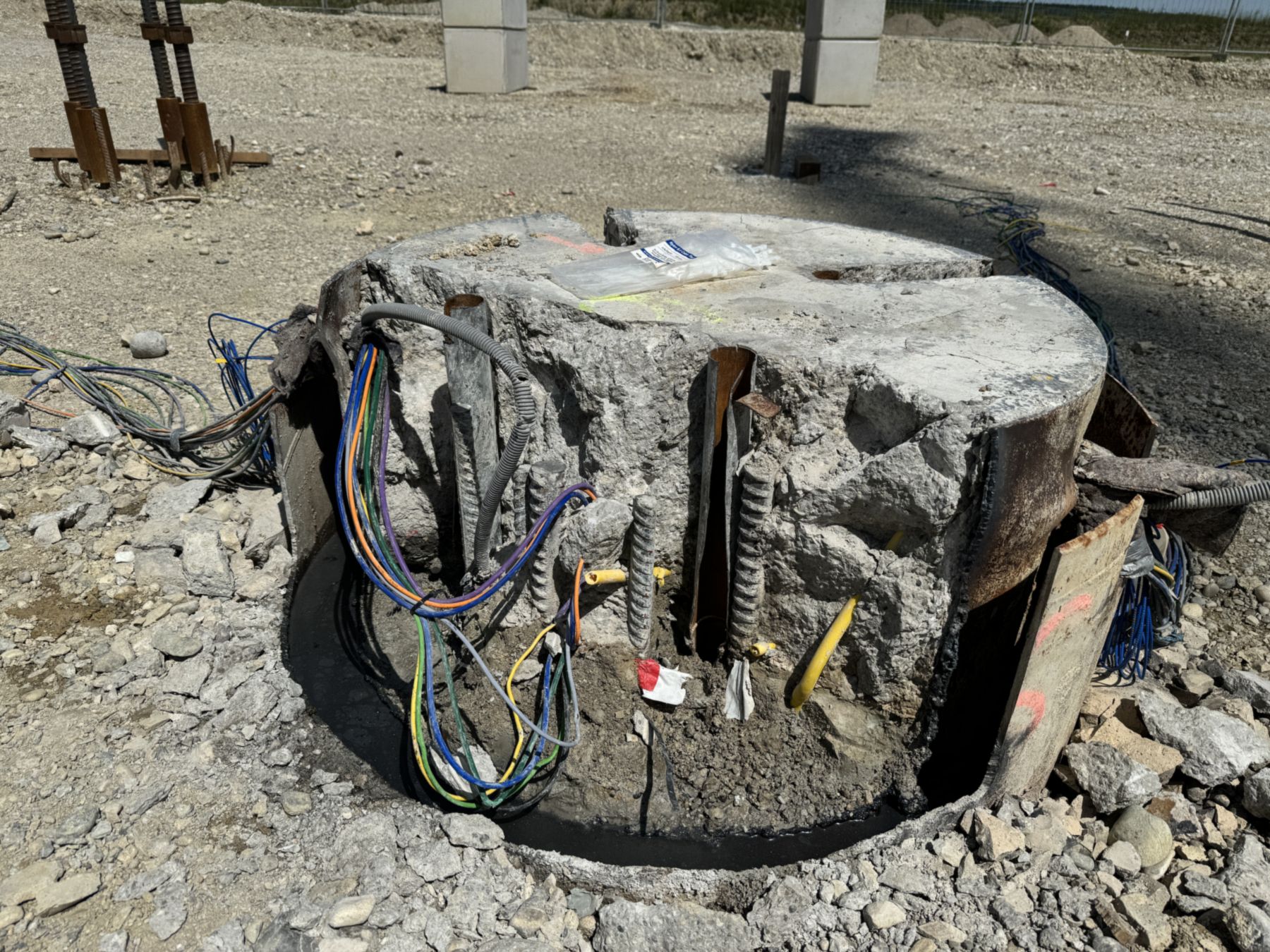
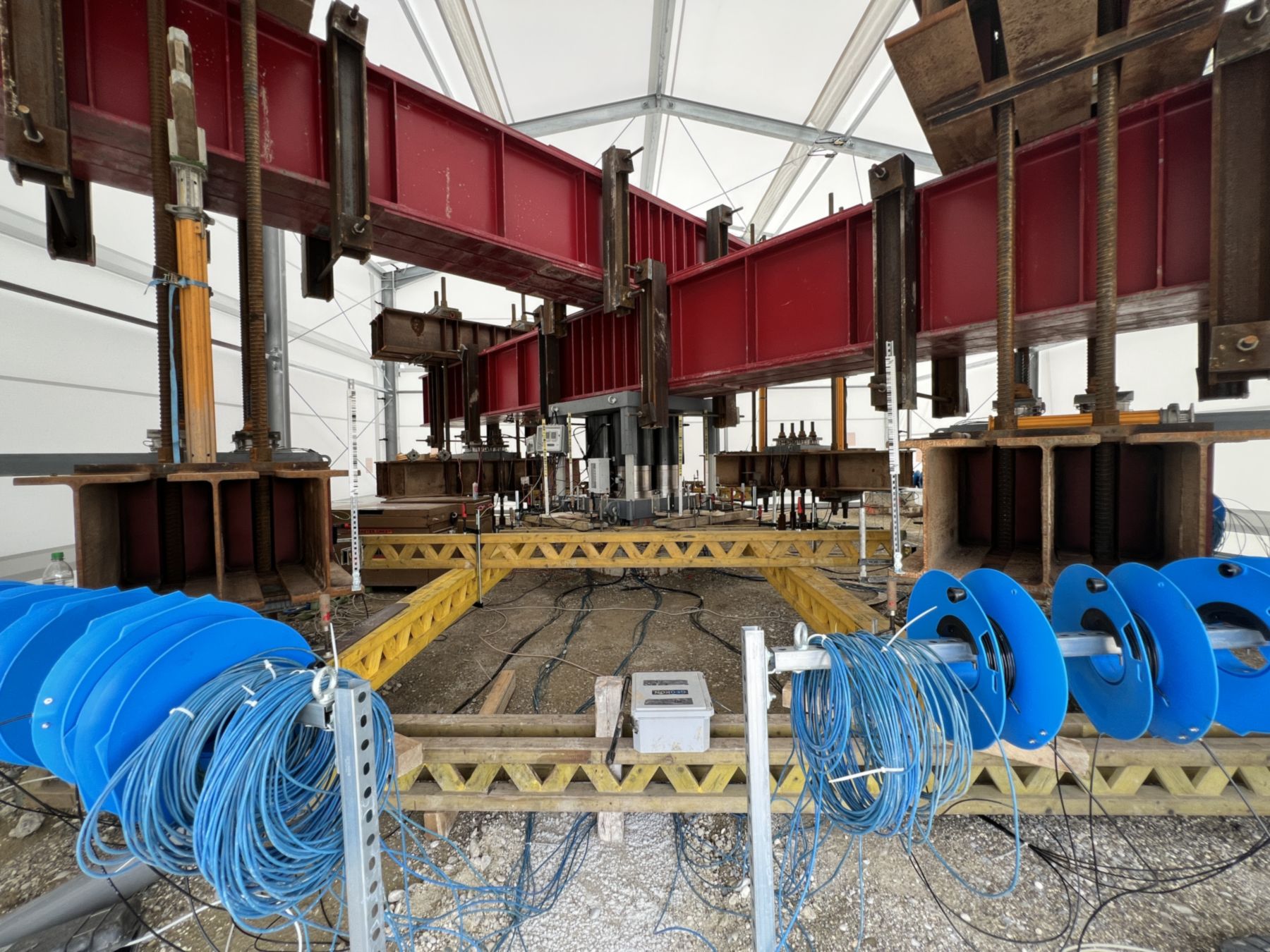
Skin friction and base resistance, reported separately. We work with sensors from Geokon, Glötzl and Bauer as well as fibre optic sensors, installed before concreting: rebar strainmeters, sister bars, base load cells, chain extensometers and chain inclinometers with up to eight measuring levels. The results are the distribution of skin friction along the pile shaft, the exact base resistance, the pile integrity and the deflection line of the pile.
Without instrumentation a load test gives the total resistance. With instrumentation it becomes visible which share comes from the shaft, how it is distributed over depth and what arrives at the base.
The gauges are mounted on the reinforcement cage before concreting and routed to the pile head via measuring lines. Measurement runs synchronously with the load control of the static load test.
Measure strain in the concrete, mounted on the reinforcement cage at several levels over the pile length. Strain gives the normal force and from that the shaft friction between levels.
strain per level
Measures strain continuously along a glass fibre cable installed with the reinforcement cage. Instead of single levels a continuous profile over the entire pile shaft is obtained.
continuous profile
Sits directly at the pile base and measures the force introduced there. The base resistance is thus a measured value, not a residual from the calculation.
base resistance directly
Records compression or extension between fixed points inside the pile, arranged as a chain over depth. Gives the displacement of individual pile sections against each other.
displacement over depth
A chain inclinometer consists of several hinged inclination sensors in a guide tube inside the pile. Each sensor measures the inclination of its section.
The individual inclinations over depth give the pile's deflection line. Up to eight measuring levels are possible.
Curing concrete releases heat. Temperature sensors inside the pile record this process while the concrete hardens.
Where the cross-section is larger or smaller than planned, the measured temperature deviates. Cross-section changes are detected without exposing the pile.
Shaft resistance along the pile, resolved by measuring level or continuously via the fibre.
Result
The share of the load introduced at the base, measured instead of calculated.
Result
Course of horizontal displacement over pile depth, derived from the inclination measurements.
Result
All questions on process, methods, standards and scheduling are in the FAQ section.
Instrumentation is part of the static load test. If the sensors stay in the structure after the test, the readings can be polled over time via remote monitoring.
Tell us the project, the number of piles and the planned test load. You will receive a test concept with a quote within two business days.